Does entity-first planning replace keyword research?
Entity-first planning does not replace keyword research, but it changes how you use keywords. Keywords still matter for understanding user intent and validating that your entities align with real search behavior. But keywords inform entity-first planning rather than drive it. You use keyword data to check that people actually search for concepts related to your entities, not to generate your topic list.
How many primary entities should a business have?
A focused B2B business typically has five to ten primary entities. More than that suggests you're not focused enough. Fewer suggests you might be missing core concepts. Start with the concepts that define what you do, how you do it, and how you're different.
How is this different from topic clusters?
Topic clusters organize content around pillar pages, often driven by keyword research. Entity-first planning organizes content around entity ownership, driven by authority goals. The outputs can look similar (pillar content with supporting content), but the logic is different. Topic clusters ask "what keywords should we cluster?" Entity-first planning asks "what concepts must we own?"
What if competitors already own our key entities?
If a competitor has dominant entity authority for a concept, you have a strategic decision: differentiate or concede. You may need to define your entity differently, find adjacent entities you can own, or invest significantly to challenge their position. Entity-first planning surfaces this reality. It doesn't make the decision for you.
How often should the entity map be updated?
Review your entity map quarterly at minimum. Update when your business evolves (new products, new positioning), when competitive dynamics shift, or when you notice gaps in AI citation performance. The entity map is a living document, not a one-time exercise.
Can I start entity-first planning with no existing content?
You can start entity-first planning with no existing content, but it's harder. The entity map becomes your content strategy from scratch. You'll need to be more speculative about what entities matter since you don't have content performance data to validate. Start with your product and methodology. What must someone understand to buy from you? Those are your starting primary entities.
Most content teams plan around keywords. They pull a list from their SEO tool, cluster by search volume, and build a calendar.
This worked when Google was the only game. It doesn't work when AI systems are the ones retrieving and citing content.
AI systems don't think in keywords. They think in entities and relationships. If your content planning starts with keywords, you're optimizing for the wrong unit.
This guide covers:
Why keyword-first planning fails for AI visibility
What entity-first content planning actually is
The three types of entities your content must address
How to build an entity map as your planning artifact
How entity maps translate into content calendars
Why entity consistency compounds citation trust
The goal: Shift your content planning from keyword lists to entity maps, so AI systems can find, understand, and cite your content.
Who this is for: Content leaders and marketers at B2B companies planning content programs. Most relevant for teams with existing products or services that need to establish authority in AI search. If you're a brand-new business still figuring out what you do, start there first. You need something to map entities from.
The Problem with Keyword-First Planning
Keyword-first planning fails for AI visibility because keywords tell you what people search, not what AI systems retrieve.
The standard process looks familiar: research keywords, filter by volume and difficulty, cluster into topics, assign to writers. The output is a calendar full of articles targeting specific search terms.
But you can rank position one for a keyword and still be invisible to AI. I see this constantly. A company ranks for "best project management software" but when you ask ChatGPT or Perplexity for project management recommendations, they're nowhere. The content exists. It ranks. But it doesn't get cited.
The reason is entity clarity. Keywords are fragments of intent. Entities are what AI systems actually understand.
When someone searches "best project management software," AI systems don't just match those words. They understand "project management software" as an entity with relationships to other entities: task management, team collaboration, Asana, Monday.com, Jira. The content that gets cited is the content that clearly positions itself within that entity landscape.
Keyword-optimized content often fails this test. It targets the phrase without establishing entity authority. The page might mention project management software repeatedly, but it doesn't:
Define the entity
Map its relationships
Differentiate from adjacent concepts
AI systems have nothing to anchor on. This is why content that ranks doesn't automatically get cited. The ranking signals and retrieval signals are different.
"In AI search, authority is entity-based rather than domain-based. Entity authority develops through consistency, presence across channels that AI systems crawl, and alignment between what a brand says, how it says it, and where it appears."
Entity-first content planning is a methodology that starts with identifying the entities your content must own, then builds content that defines those entities and maps their relationships.
The shift looks like this:
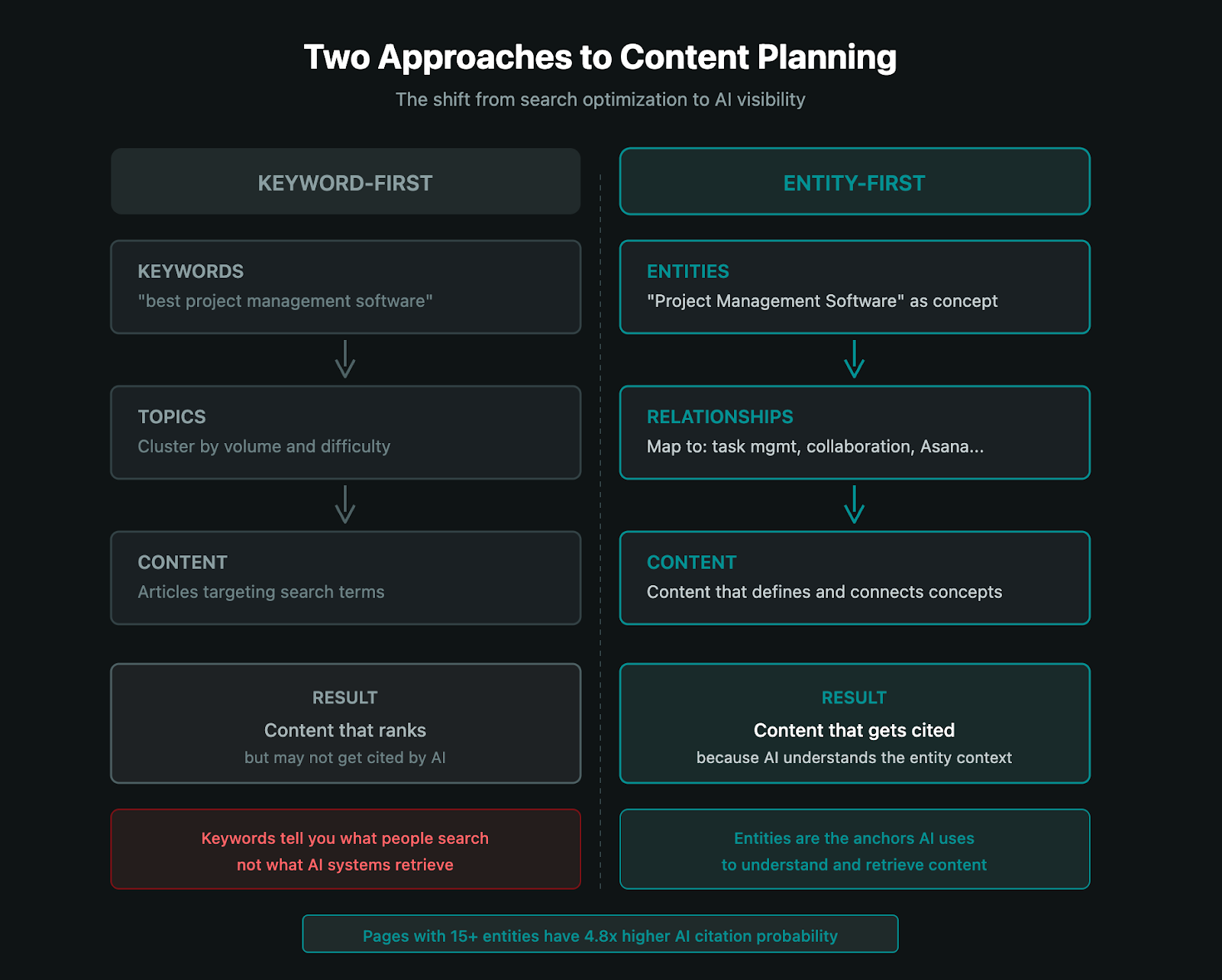
Keyword-first: Keywords → Topics → Content
Entity-first: Entities → Relationships → Content
Instead of asking "what keywords should we target?", you ask "what entities must we be the authoritative source for?" Instead of clustering keywords by volume, you map entities by relationship and business value.
The output is different too. Keyword-first produces a list of articles to write. Entity-first produces an entity map: a structured view of the concepts you must own, how they connect, where you have coverage, and where you have gaps.
This is a fundamental shift in how Content Engineering approaches planning. Rather than optimizing pages for search terms, you're designing a content system that establishes authority over concepts.
What This Is Not
Entity-first planning is not "entity SEO" in the narrow sense. Entity SEO often means schema markup, structured data, knowledge panel optimization. Those are implementation tactics. Entity-first planning is about how you decide what to create in the first place.
Entity-first planning is also not a replacement for keyword research. Keywords still matter for signaling user intent and understanding how people phrase questions. But keywords inform entity-first planning rather than drive it. You use keywords to validate that your entities align with real search behavior, not to generate your topic list.
Why Entities Are the Unit AI Systems Understand
Entities are the anchors AI systems use to understand and retrieve content. Keywords are fragments of language, but entities are the concepts that give language meaning.
AI systems retrieve content based on semantic similarity, not keyword matching. When you submit a query, the system converts it into a mathematical representation and finds content that's semantically close. This is how RAG (Retrieval-Augmented Generation) systems work at a fundamental level.
When you search for "CRM," AI systems understand CRM as an entity with relationships: sales pipeline, customer data, lead management, Salesforce, HubSpot, Zoho. Content that clearly associates itself with those entity relationships gets retrieved. Content that just uses the word "CRM" without establishing entity context gets overlooked.
A 2025 study analyzing 15,847 AI Overview results found that pages with 15 or more recognized entities had a 4.8x higher probability of being selected for citations. Entity density, not keyword density, is what drives AI visibility. (AI Overview Ranking Factors Study, 2025)
This is why entity clarity matters for citation. AI systems need to understand what your content is about at the entity level, not just the keyword level. When your entity definitions are clear and consistent, you become a citable source. When they're vague or inconsistent, you don't.
"SEOs are starting to wake up to the profound difference between an entity vs keyword approach to content strategies. Google now has a large and sophisticated Knowledge Graph, which helps it understand the relationships between concepts."
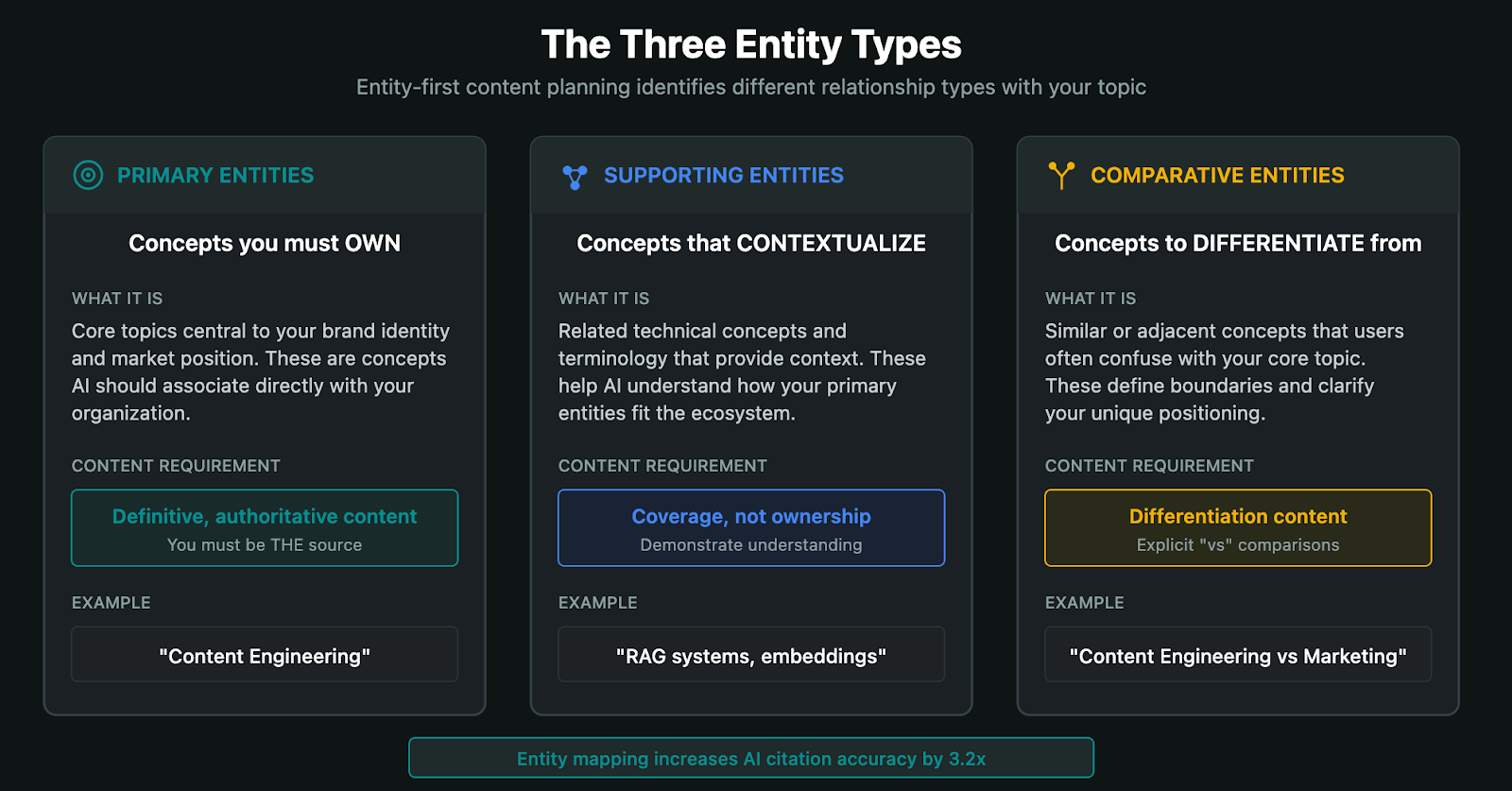
Entity-first planning recognizes three distinct types of entities: primary, supporting, and comparative. Each requires different content treatment.
Primary Entities
Primary entities are the concepts you must own. These are the definitions your brand must be the authoritative source for.
Every business has primary entities, usually five to ten. They're the core concepts that define what you do, how you do it, and how you're different.
For VisibilityStack, "Content Engineering" is a primary entity. We must be the definitive source for what content engineering means, how it works, and why it matters. If someone asks an AI system "what is content engineering?", our definition should be what gets cited.
Primary entities require definitive content. Not just mentions, but comprehensive treatment that establishes your authority. A blog post that touches on the concept isn't enough. You need content that owns the definition.
Supporting Entities
Supporting entities are concepts that contextualize your primary entities. You need content on these, but you don't need to be the definitive source.
These are the related concepts, technical foundations, and adjacent ideas that make your primary entities make sense. For Content Engineering, supporting entities include RAG systems, passage architecture, embeddings, and semantic similarity. We write about these to contextualize our primary entity, but we're not trying to own the definition of "embeddings." That's not our territory.
Supporting entities require coverage, not ownership. You need enough content to establish context and demonstrate expertise, but you're linking to and building on others' definitions rather than replacing them.
Comparative Entities
Comparative entities are alternatives, competitors, or adjacent concepts that your content must differentiate from.
These are the "vs" opportunities: Content Engineering vs Content Marketing, Content Engineering vs Content Strategy. They're also the competitive comparisons: your product vs alternatives in the category.
Comparative entities require differentiation content. Not attack pieces, but clear articulation of what makes your primary entities distinct. This is where you draw boundaries and establish positioning.
The content that addresses comparative entities must be fair. Misrepresenting competitors or adjacent concepts damages trust. But clear, honest differentiation is essential for AI systems to understand where your authority begins and ends.
The Entity Map: Your New Planning Artifact
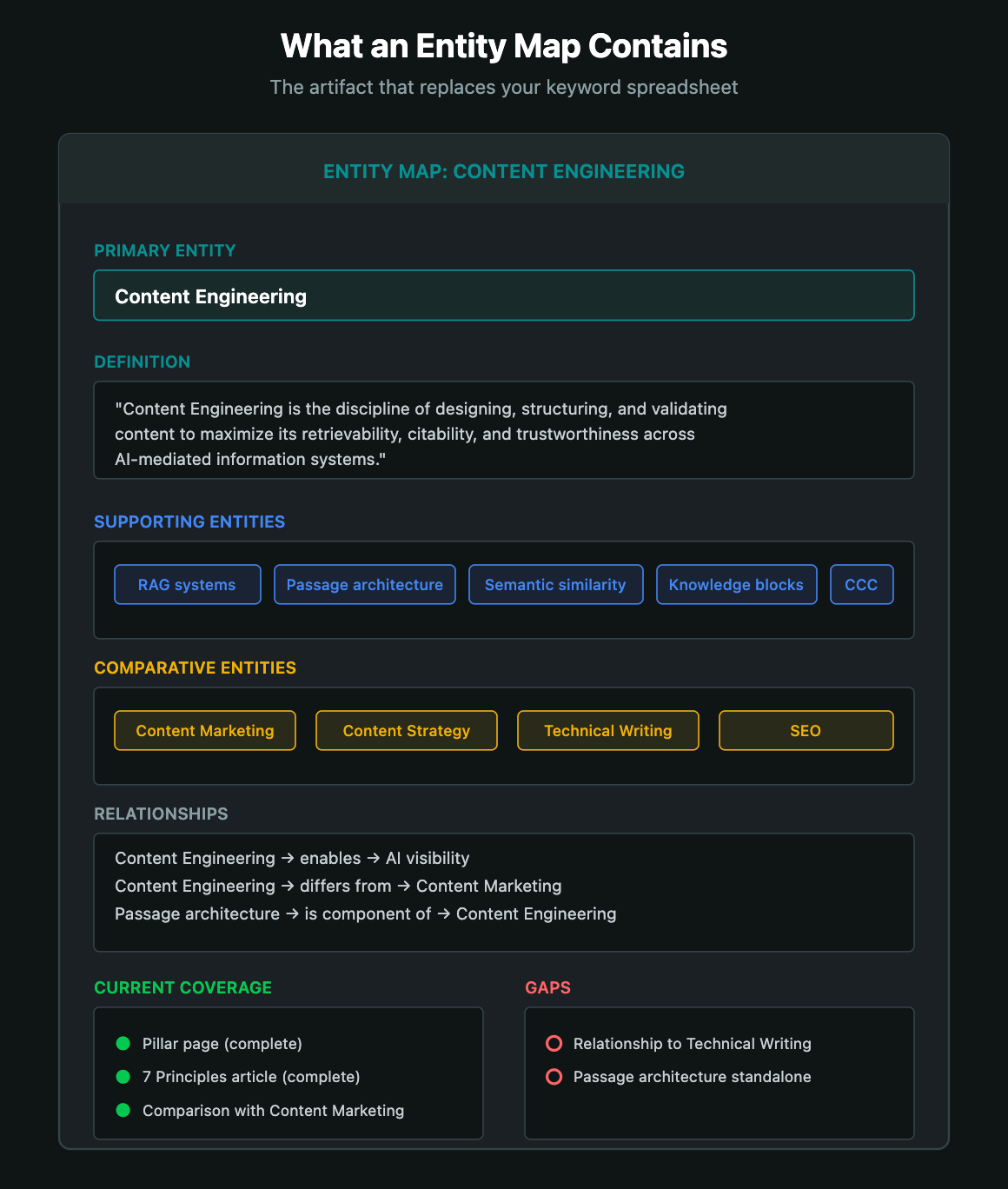
The entity map is a structured document that captures your entities, their definitions, their relationships, and your coverage status. It replaces (or sits above) your keyword spreadsheet as the source of truth for content decisions.
An entity map captures:
Your primary entities and their explicit definitions
Supporting entities for each primary entity
Comparative entities and differentiation angles
Relationships between entities
Current content coverage status
Gaps where you lack coverage
The entity map is a living document. It evolves as your business evolves, as you learn more about your space, and as competitive dynamics shift.
"Instead of chasing isolated keywords, you claim and reinforce a small set of core entities. Instead of fragmented content, you build interconnected topic clusters that mirror how your buyers think about problems and solutions."
At its simplest, an entity map is a structured document with each primary entity as a section:
This structure gives you a clear view of what you own, what you're missing, and what to prioritize next.
Building Your Entity Map
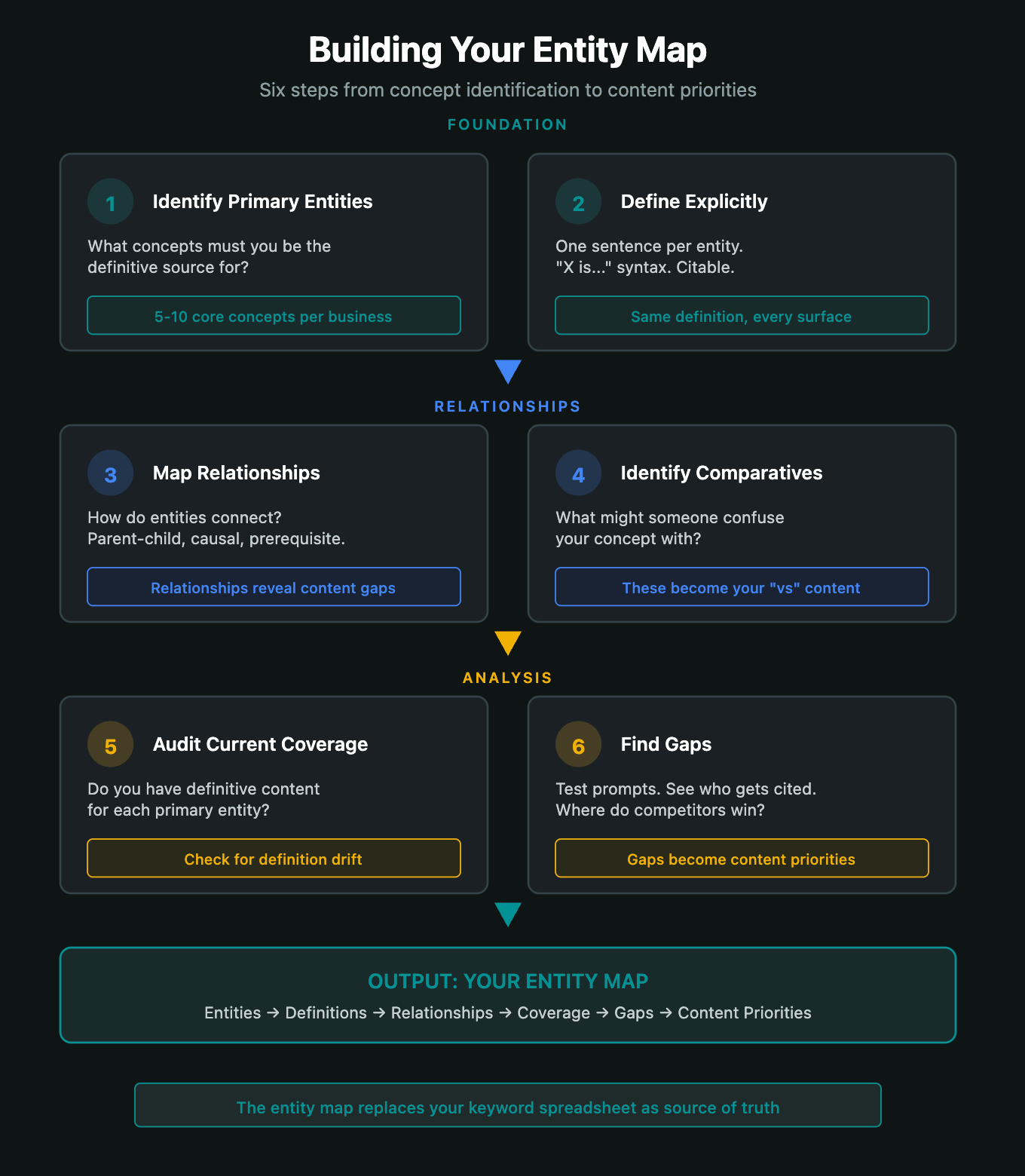
Building an entity map requires six steps: identify your primary entities, define each explicitly, map relationships, identify comparative entities, audit current coverage, and find gaps. Here's the methodology for each.
Step 1: Identify Your Primary Entities
Your primary entities are the concepts your business must be the definitive source for. Start by looking at your product, your methodology, and your category.
What terms do you use repeatedly? What concepts do customers need to understand to buy from you? What would hurt if a competitor owned the definition?
For most focused B2B businesses, this is five to ten entities. More than that and you're probably not focused enough. Fewer and you might be missing something core.
Entity extraction from your existing content and product documentation can surface candidates you haven't explicitly named. Look at what concepts appear repeatedly across your materials.
Step 2: Define Each Entity Explicitly
Every primary entity needs an explicit, citable definition: one sentence, using "X is..." syntax, clear enough to stand alone.
This is harder than it sounds. Most businesses have fuzzy definitions of their core concepts. They use terms without defining them. They define the same concept differently in different places.
The definitional structure that AI systems prefer is direct and categorical:
✓ "Content Engineering is the discipline of..."
✗ "Content Engineering can be thought of as..."
✗ "We believe Content Engineering means..."
Write the definition, then check: does this exact definition appear on your website? In your docs? On your LinkedIn? If it varies, you have a consistency problem that entity-first planning will expose.
Understanding how AI models decide what content to cite helps here. AI systems prefer explicit, unambiguous definitions because they reduce the risk of hallucination when citing your source.
Step 3: Map Relationships
Entities connect to each other, and mapping those relationships reveals content opportunities while ensuring your entity coverage is coherent.
Common relationship types:
Hierarchical: Parent-child relationships. Content Engineering includes passage architecture. Passage architecture is a component of Content Engineering.
Comparative: A vs B relationships. Content Engineering differs from Content Marketing.
Prerequisite: Understanding X requires understanding Y. Understanding Content Engineering requires understanding how AI systems retrieve content.
Causal: X enables or causes Y. Entity-first planning improves AI visibility.
You don't need a complex ontology. A simple list of relationships for each primary entity is enough to guide content planning.
Step 4: Identify Comparative Entities
For each primary entity, list the alternatives, adjacent concepts, and competitive options that require differentiation content.
What might someone confuse your concept with? What are the adjacent ideas? What are the competitive alternatives?
These become your differentiation content opportunities. Every primary entity probably has two to five comparative entities worth addressing.
Step 5: Audit Current Coverage
With your entity map in hand, audit your existing content to identify where you have authority and where you have gaps.
For each primary entity, ask:
Do you have definitive content that establishes your authority?
Is your definition consistent across all surfaces?
Do you cover the key supporting entities?
Have you addressed the main comparative entities?
This audit often reveals uncomfortable gaps. You may have 50 blog posts but no definitive content on your most important entity. You may discover your definition changes between your homepage and your blog.
Step 6: Find Gaps
Gap analysis identifies where competitors are getting cited that you're not, and what entities they own that you should own.
This requires looking at what AI systems currently cite for queries in your space. Test prompts in ChatGPT, Perplexity, and Claude. See who gets cited. Analyze what those sources have that you don't.
Surfer SEO's AI Citation Report, analyzing 36 million AI Overviews and 46 million citations, found that a small number of domains capture a disproportionate share of citations in any given industry. The top 20 domains in any vertical account for over 66% of all citations. If you're not one of those top entities in your space, you're invisible. (Surfer SEO, 2025)
Entity coverage gaps become your content priorities. Not because a keyword has volume, but because an entity has authority opportunity.
Manually running these gap analyses across four AI platforms is tedious and inconsistent. VisibilityStack's Topical Authority Engine™ maps these gaps automatically, showing which entities you need to own to get cited, and where competitors are winning the entity authority race.
From Entity Map to Content Calendar
An entity map is the input to a content calendar, not the calendar itself. The translation follows a clear logic.
Primary entities drive pillar content. Each primary entity needs a comprehensive, definitive piece. This is your authority anchor for that concept. Without it, you can't own the entity.
Relationships drive supporting content. Each relationship suggests a content opportunity. "Content Engineering enables AI visibility" suggests content on how and why. "Passage architecture is a component of Content Engineering" suggests content that goes deep on passage architecture.
Gaps drive priorities. If a competitor is cited for an entity you should own, that's a priority. If you have no content on a primary entity, that's urgent. If your definitions are inconsistent, fixing that comes before creating new content.
Entity prioritization determines sequence. Not all entities are equally important. Some have higher business value. Some have more citation opportunity. Some are prerequisites for others. Prioritization methodology turns a flat list of gaps into a sequenced calendar.
The Knowledge Architect role owns this translation in mature content teams. They maintain the entity map and ensure the content calendar reflects entity priorities, not just keyword opportunities.
"Shift from tracking keyword overlap to evaluating content depth, originality, and entity coverage, where your brand's expertise can fill gaps or improve on generic AI-summarized answers."
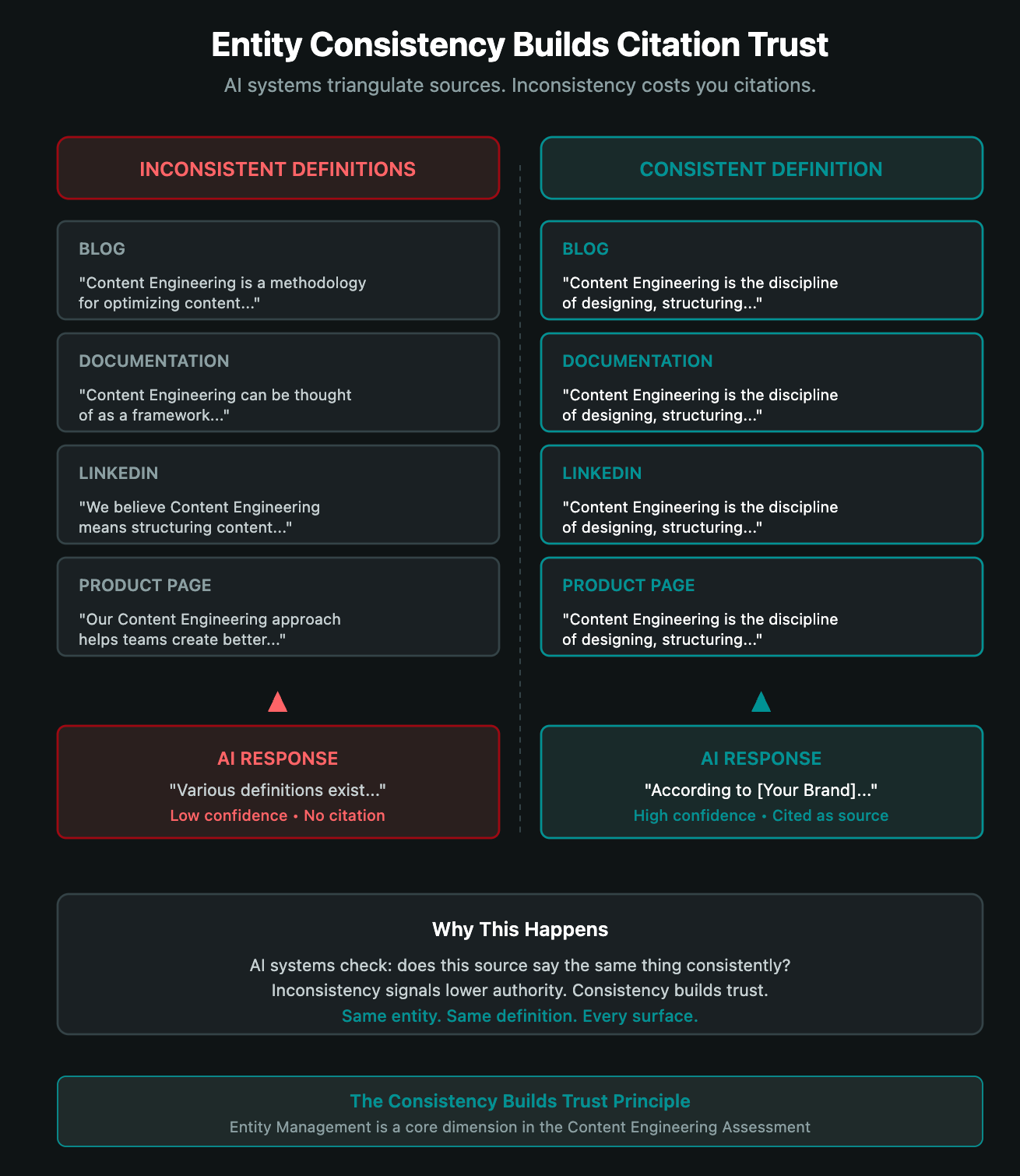
Consistent entity definitions across all surfaces build citation trust because AI systems triangulate sources and inconsistency signals lower authority.
When AI systems encounter your content, they check: does this source say the same thing consistently? If your definition of Content Engineering varies between your blog, your docs, your LinkedIn posts, and your product pages, AI systems notice. Inconsistency reduces confidence in your authority.
Conversely, when your entity definitions are identical across every surface, AI systems gain confidence. You become the stable, reliable source. That reliability translates into citation preference.
This is the Consistency Builds Trust principle applied to planning. The entity map enforces consistency by establishing canonical definitions. Every piece of content references the same definitions. Every writer uses the same terminology.
Research from Content Marketing Institute's 2026 Trends report reinforces this.
"If you want your content to be visible in [Google's] AI feature, use structured data. Make sure to connect entities and topics. This will provide context for the machines and allow you to see what topics and entities you are an authority on."
Where most teams fail is at scale. Manual consistency is possible with 20 pages. With 200 pages across multiple writers and years of content, it becomes impossible. Definitions drift. Terminology varies. The entity landscape fractures.
This is why Entity Management is a dimension in the Content Engineering Assessment. It's a leading indicator of whether your content will be trusted at scale.
Scaling Entity-First Planning
The methodology described above works for manual implementation, but maintaining entity consistency becomes impossible at scale without systems.
A content leader can identify entities, define them, map relationships, and find gaps in a spreadsheet. The challenge is maintenance:
Entity maps need to evolve as your business evolves
Competitor analysis needs to be ongoing, not one-time
Consistency needs to be enforced across every piece of content
At a certain content volume, typically around 100 pages, manual entity management becomes a full-time job. Beyond that, it becomes impossible without systems.
"You need to be the entity referenced in the generative answer so that users, and agents, trust you."
In the era of AI agents making purchasing decisions on behalf of users, owning entity definitions isn't just about visibility. It's about being the trusted source that autonomous systems rely on.
At Tech SEO Connect 2025, speakers emphasized that defining entities deeply using Schema properties to create semantic triples (subject, predicate, object) is now essential for AI visibility. One case study showed how robust entity-connected schema markup led to AI Overviews citing the correct pages instead of outdated competitor information. (Lily Ray, Tech SEO Connect 2025)
With VisibilityStack: The Topical Authority Engine™ automates the foundational entity mapping work. It crawls your site to map current entity coverage, extracts entities from competitors who get cited for your target queries, and reveals gaps between your coverage and theirs. The output is a prioritized list of entity opportunities based on both business value and citation potential.
VisibilityStack's Crawl Assurance Engine™ then verifies that AI systems can actually access and parse your entity-rich content, while the Trust Signal Engine™ identifies which high-authority placements will strengthen your entity credibility with AI platforms.
You still make the strategic decisions: which entities matter most, what your definitions should be, how to differentiate from competitors. But the systematic analysis and consistency enforcement happens automatically.
Action Checklist
Identify Your Entities
List the 5-10 concepts your business must be the definitive source for
Write one-sentence definitions using "X is..." syntax
Check if those definitions appear consistently across your current content
Map Your Entity Landscape
List 3-5 supporting entities for each primary entity
List 2-5 comparative entities for each primary entity
Document the key relationships between entities
Audit and Prioritize
For each primary entity, identify whether you have definitive content
Test prompts in AI systems to see who gets cited for your key entities
List gaps where competitors have coverage you lack
Prioritize gaps by business value and citation opportunity
Enforce Consistency
Establish canonical definitions that all content must use
Review existing content for definition drift
Build entity definitions into your content briefs and style guide
Key Takeaways
Keyword-first planning optimizes for the wrong unit. Keywords tell you what people search. Entities tell you what AI systems understand. Planning around keywords produces content that ranks but doesn't get cited.
Entity-first planning starts with ownership. The first question isn't "what keywords should we target?" It's "what entities must we be the authoritative source for?"
Three entity types require different treatment. Primary entities need definitive content. Supporting entities need contextual coverage. Comparative entities need differentiation.
The entity map is your new planning artifact. It captures entities, definitions, relationships, coverage status, and gaps. It replaces or sits above your keyword spreadsheet.
Relationships reveal content opportunities. Mapping how entities connect shows you what content to create, not just what topics to cover.
Consistency compounds trust. Same entity, same definition, every surface. AI systems triangulate, and inconsistency costs you citations.
Manual entity management doesn't scale. The methodology works by hand for small content libraries. At scale, you need systems that maintain consistency and surface gaps automatically.
Share This Article:
Written By:
Pushkar Sinha
Co-Founder & Head of SEO Research
Reviewed By:
Ameet Mehta
Co-Founder & CEO
FAQs
Does entity-first planning replace keyword research?
Entity-first planning does not replace keyword research, but it changes how you use keywords. Keywords still matter for understanding user intent and validating that your entities align with real search behavior. But keywords inform entity-first planning rather than drive it. You use keyword data to check that people actually search for concepts related to your entities, not to generate your topic list.
How many primary entities should a business have?
A focused B2B business typically has five to ten primary entities. More than that suggests you're not focused enough. Fewer suggests you might be missing core concepts. Start with the concepts that define what you do, how you do it, and how you're different.
How is this different from topic clusters?
Topic clusters organize content around pillar pages, often driven by keyword research. Entity-first planning organizes content around entity ownership, driven by authority goals. The outputs can look similar (pillar content with supporting content), but the logic is different. Topic clusters ask "what keywords should we cluster?" Entity-first planning asks "what concepts must we own?"
What if competitors already own our key entities?
If a competitor has dominant entity authority for a concept, you have a strategic decision: differentiate or concede. You may need to define your entity differently, find adjacent entities you can own, or invest significantly to challenge their position. Entity-first planning surfaces this reality. It doesn't make the decision for you.
How often should the entity map be updated?
Review your entity map quarterly at minimum. Update when your business evolves (new products, new positioning), when competitive dynamics shift, or when you notice gaps in AI citation performance. The entity map is a living document, not a one-time exercise.
Can I start entity-first planning with no existing content?
You can start entity-first planning with no existing content, but it's harder. The entity map becomes your content strategy from scratch. You'll need to be more speculative about what entities matter since you don't have content performance data to validate. Start with your product and methodology. What must someone understand to buy from you? Those are your starting primary entities.
Turn Organic Visibility Gaps Into Higher Brand Mentions
Get actionable recommendations based on 50,000+ analyzed pages and proven optimization patterns that actually improve brand mentions.



 The Rise of AI SearchMcKinsey research on AI adoption in enterprise
.png)