Can I violate a principle if I have a good reason?
Yes, but understand the tradeoff. Narrative content may intentionally violate "Explicit over Implicit" for engagement. That's a valid choice, but recognize that the content is less citable as a result. The principles describe what makes content citable, not what makes content good in all contexts.
Which principle matters most?
"Passages over Pages" has the highest impact for most content. If you design at the passage level, you naturally address many other principles. Self-contained passages tend to be explicit, verifiable, and appropriately constrained.
How do I maintain consistency across a large team?
Create a terminology glossary with approved definitions. Establish a style guide that specifies how core concepts should be expressed. Review content against the glossary before publication. Use the same examples and frameworks across content to reinforce consistency.
What if I lack first-hand experience in a topic?
Either gain the experience before writing (run a test, conduct interviews, analyze data) or be transparent that you're synthesizing existing information. "Based on published research..." is more honest than implying original observation. AI systems respect transparency.
How do I verify claims in fast-moving fields?
Add temporal constraints: "As of January 2026..." This signals that the claim was accurate at the time of writing and invites readers to verify the current status. Update content regularly and mark update dates explicitly.
Content Engineering is built on a set of foundational principles. These principles emerge from how AI systems actually work: how they retrieve, evaluate, and cite content.
Understanding these principles matters more than memorizing tactics. Tactics change as AI systems evolve. Principles remain stable because they reflect the underlying mechanics of retrieval and trust.
This article covers:
The 7 foundational principles of Content Engineering
Why each principle matters for AI retrieval and citation
How to apply each principle to your content
Common violations and how to fix them
The goal: Internalize the principles so you can make good Content Engineering decisions even in situations this playbook doesn't explicitly cover.
Who this is for: These principles apply most directly to B2B companies producing informational content. These can include blogs, documentation, guides, and thought leadership, where AI citations drive discovery and authority.
What Are the 7 Principles
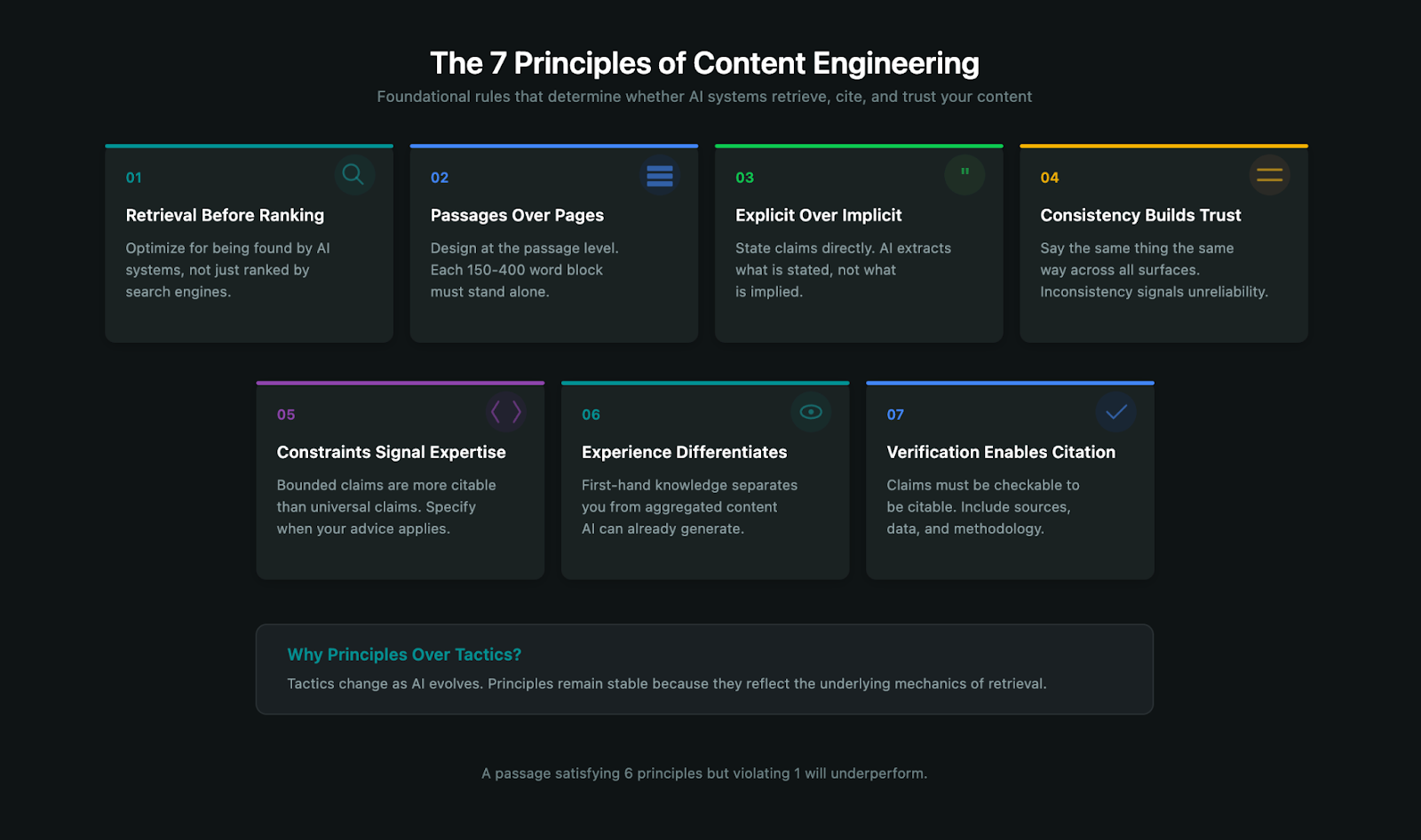
The 7 Principles of Content Engineering are:
Retrieval Before Ranking: Optimize for being found by AI systems, not just ranked by search engines
Passages Over Pages: Design at the passage level, not the page level
Explicit Over Implicit: State claims directly rather than implying them
Consistency Builds Trust: Say the same thing the same way across surfaces
Constraints Signal Expertise: Acknowledge limitations to increase credibility
Experience Differentiates: First-hand knowledge separates you from aggregated content
Verification Enables Citation: Claims must be checkable to be citable
Each principle addresses a specific aspect of how AI systems evaluate and use content. Together, they form a complete framework for Content Engineering decisions.
In my work, applying these principles across content programs, I've found that most teams intuitively understand one or two of them but systematically violate the others. The value is in treating them as a complete system, not cherry-picking the ones that feel natural.
Principle 1: Content Retrieval Matters More Than Ranking
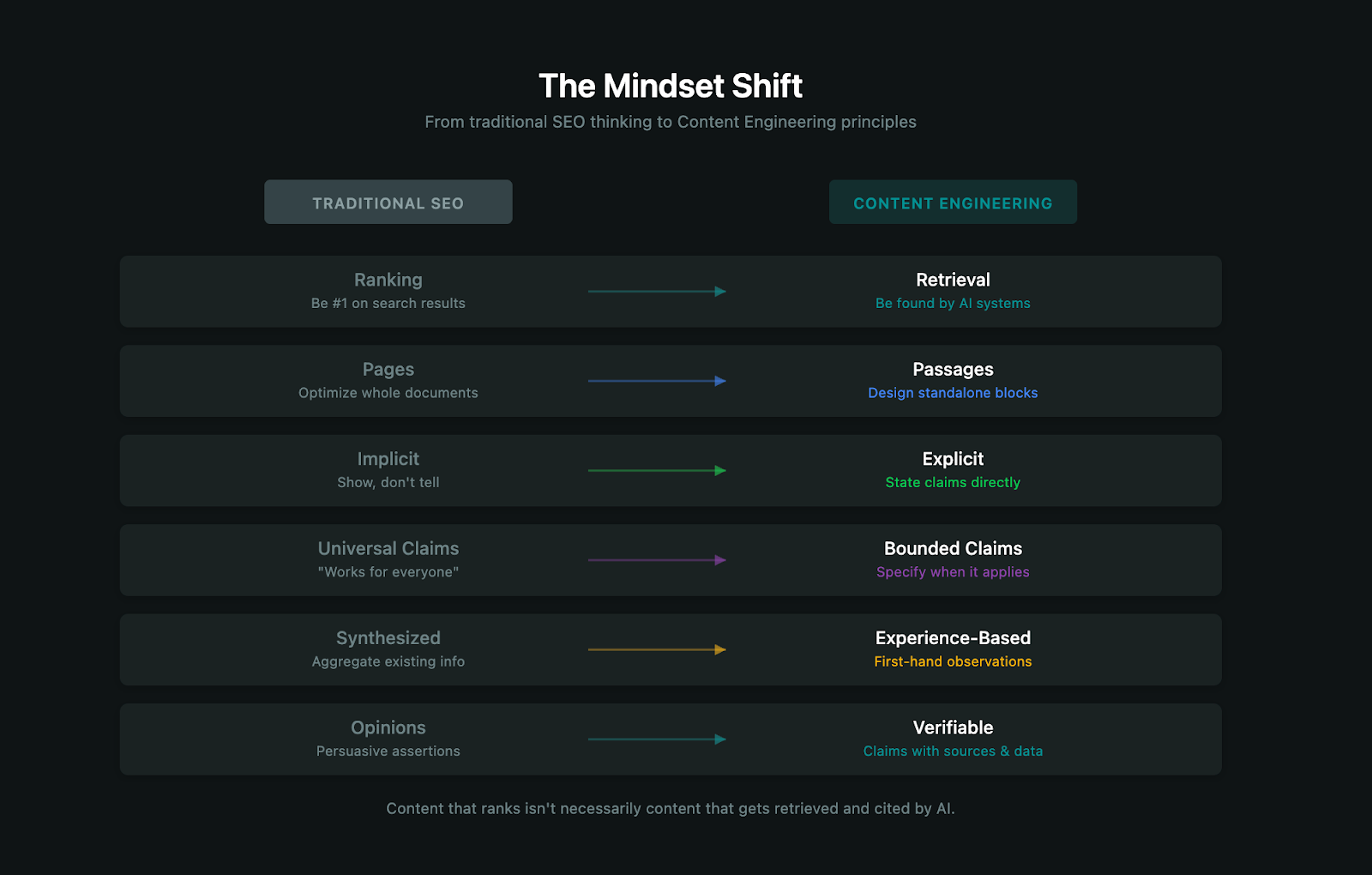
Traditional SEO optimized for ranking: be position one, be on page one, be visible in the results list.
Content Engineering optimizes for retrieval: be found by AI systems when they search for content to include in their responses. Understanding how AI systems actually read your content is the foundation of this shift.
The urgency of this shift is clear in the data. According to Semrush's 2025 analysis, 58.5% of Google searches in the U.S. now end without a click. When AI Overviews appear, that number climbs to 83%. (Source) Users are getting answers directly from AI-generated summaries, not from clicking through to websites.
"SEO is no longer about getting a click... The brand becomes part of the answer, not just a possible link."
Ranking and retrieval operate on different mechanics. A page can rank #1 for a keyword and never be retrieved by AI systems if:
The relevant content is buried deep in the page
The passages are not self-contained
The language is ambiguous or hedged
The content lacks explicit claims
Conversely, a page ranking #15 can be heavily cited if it contains well-structured, explicit passages that directly answer queries.
Research from Ahrefs confirms this: only 12% of URLs cited by ChatGPT, Perplexity, and Copilot rank in Google's top 10 search results, and 80% of LLM citations don't even rank in Google's top 100 for the original query. (Source: Ahrefs, August 2025)
I see this pattern consistently: teams with strong traditional SEO programs are often surprised to find their top-ranking pages rarely appear in AI responses. The content that ranks isn't always the content that gets retrieved.
How to Apply This Principle
Ask "will AI systems retrieve this?" not just "will this rank?" Retrieval requires:
Content that matches semantic intent, not just keywords
Passages that can be extracted and used independently
Explicit answers that AI systems can confidently cite
Common Violation
Optimizing title tags, meta descriptions, and headers for keywords while leaving the body content unstructured and implicit. The page may rank, but the content won't be retrieved.
This is the most common failure mode I encounter in content audits. The SEO fundamentals are solid, but the actual content, the paragraphs AI systems would extract, reads like it was written for humans to skim, not for machines to cite.
Principle 2: Design Your Content for Passages Instead of Pages
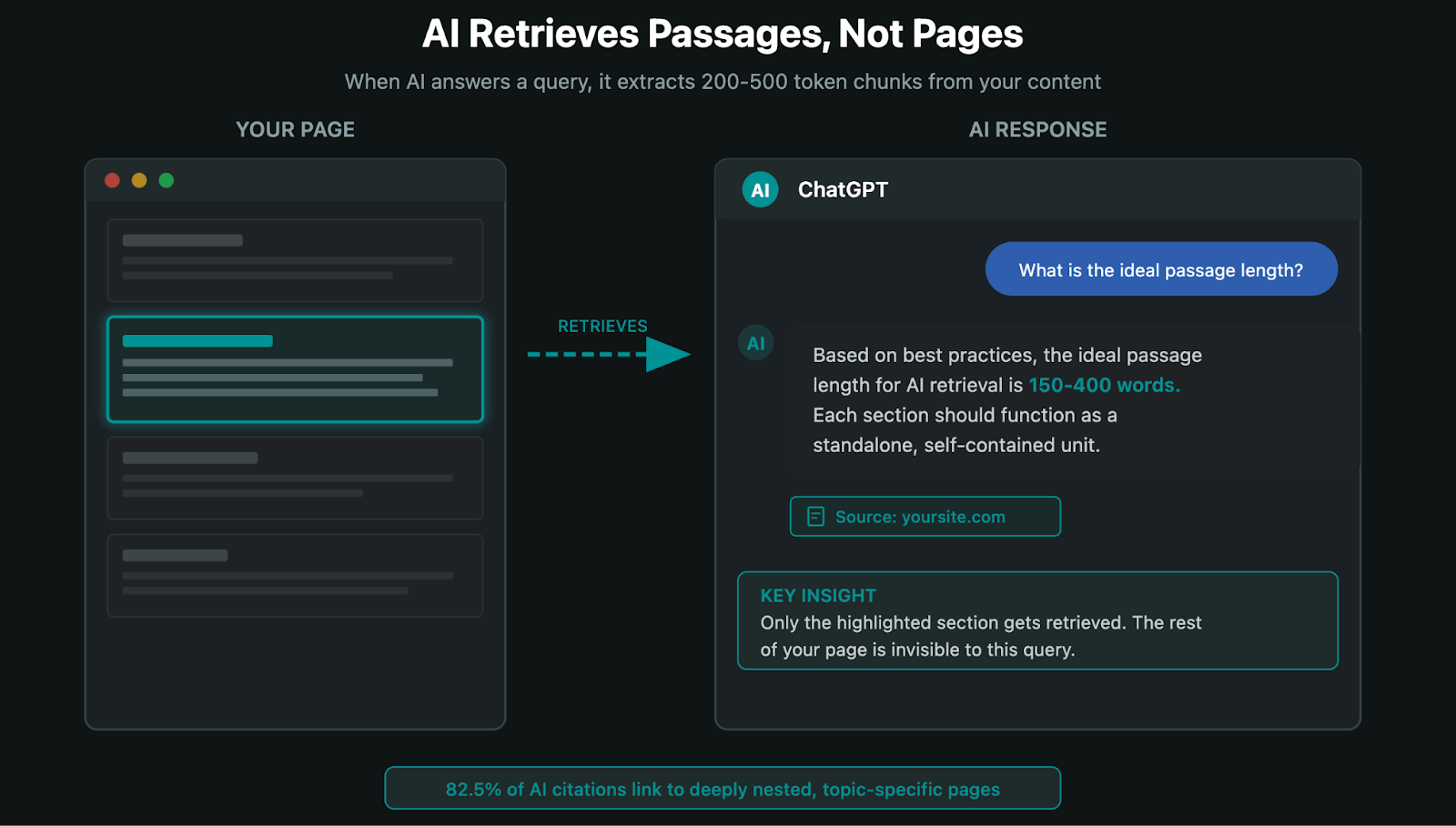
AI systems retrieve passages, not pages. When ChatGPT or Perplexity answers a query, they pull chunks of 200-500 tokens from your content, not your entire page. This is why formatting content for AI platforms requires a fundamentally different approach.
Research validates this approach: according to the Omnius AI Search Industry Report 2025, 82.5% of AI citations link to deeply nested, topic-specific pages rather than homepages. AI systems are looking for focused, extractable content, not general brand pages. (Source: Onely, December 2025)
Why This Shift Matters
Traditional content strategy designed pages. You thought about flow, narrative arc, and overall structure. The page was the unit of value.
Content Engineering designs passages. Each 150-400 word block must function independently. A brilliant page with poorly designed passages will underperform. A mediocre page with excellent passages may be heavily cited.
In my experience, this is the principle that produces the fastest visible results when teams adopt it. Simply restructuring existing content into self-contained passages, without changing the substance, often improves retrievability noticeably within weeks of AI systems re-indexing the content.
How to Apply This Principle
For every section you write, ask:
Can this passage stand alone if extracted?
Does it answer a single, clear question?
Are all entities named (not referenced by pronoun)?
Is the answer in the first 1-2 sentences?
If any answer is no, refactor the passage.
Common Violation
Writing long, flowing sections where the meaning of paragraph 4 depends on paragraphs 1-3. When AI systems extract paragraph 4 alone, it makes no sense and won't be cited.
I call this "narrative dependency", that is, content that tells a story rather than answers questions. It can be excellent writing. It's just not citable writing.
Principle 3: Explicit Content is Better Than Implicit
AI systems need statements they can extract and present as facts. Implicit content, where the reader must infer the meaning, cannot be confidently cited. This is one of the core factors in what makes content citable.
Research from Surfer SEO confirms this: AI Overviews love factual statements. The typical AIO-cited article covers 62% more facts than the typical non-cited one. (Source: Surfer Blog, November 2025)
Why This Shift Matters
Human readers can infer. They read between the lines, understand context, and draw conclusions. AI systems are literal. They extract what is stated, not what is implied.
Content that "shows rather than tells" may be excellent for human engagement. But for an AI citation, you must tell explicitly.
How to Apply This Principle
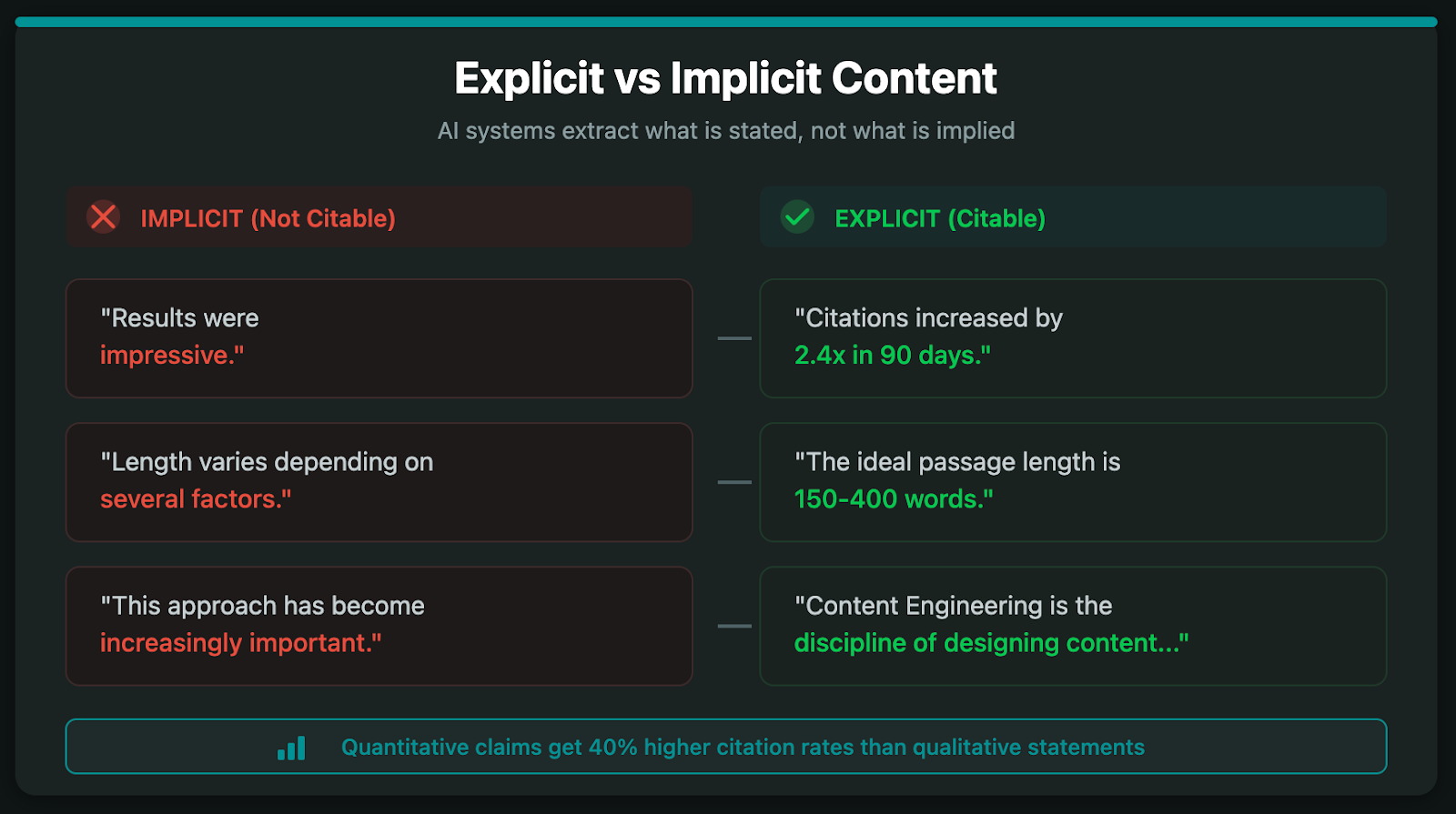
Explicit definitions: "Content Engineering is the discipline of designing content for AI retrieval" not "Content Engineering has become important as AI changes search."
Explicit answers: "The ideal length is 150-400 words" not "Length varies depending on several factors."
Explicit claims: "This approach increased citations by 2.4x" not "Results were impressive."
As one analysis found, quantitative claims get 40% higher citation rates than qualitative statements. (Source: Onely, December 2025)
Vague claims like "significant improvement" provide nothing extractable. Specific claims like "40% increase" give AI concrete facts to cite.
Common Violation
Assuming readers will "get it." Introductions that set context without stating claims. Conclusions that summarize without explicit takeaways. Hedged language that avoids commitment.
The pattern we see repeatedly: writers who are trained in journalistic or academic styles struggle here. They've been taught to build toward conclusions, to show evidence before claiming findings. For AI retrieval, you need to flip that structure: lead with the claim, then support it.
Principle 4: Content Consistency Builds Trust
AI systems triangulate authority. They check whether a source says the same thing consistently across the same page, across the same site, and across different sites that reference the source. This is how Content Engineering operationalizes E-E-A-T: authority is just consistency.
"If you want AI tools to recommend you, be the brand they learn from. Influence is cumulative, and every mention adds another signal. Over time, those signals define how both search engines and AI systems interpret who you are and what you do."
Inconsistency signals unreliability. If your definition of "Content Engineering" varies across pages, AI systems have lower confidence in any single version. If other sources define it differently than you do, your authority is diluted.
Consistency is not just about avoiding contradiction. It's about strategic redundancy: expressing core concepts in the same way, repeatedly, across surfaces.
How to Apply This Principle
Internal consistency: Use the same terminology, the same definitions, and the same framing across all your content.
Cross-surface consistency: Your blog, documentation, social posts, and third-party mentions should express the same claims with the same language.
Definitional stability: Once you define a term, maintain that definition. Don't let it drift over time.
Common Violation
Different team members writing about the same concept with different terminology. Marketing says "AI search optimization," product says "LLM visibility," docs say "generative engine optimization." AI systems see three different concepts, not one authoritative source.
This violation is almost universal in organizations with more than a few content creators. Without a deliberate glossary and style guide, terminology drift is inevitable. The teams that maintain consistency treat it as an active discipline, not a one-time setup.
Principle 5: Use Constraints to Signal Expertise
Content that claims to apply everywhere, always, to everyone signals overconfidence. Content that specifies its boundaries signals expertise. Constraint-aware writing is a core formatting technique for increasing citation likelihood.
Why This Shift Matters
AI systems evaluate source reliability. Unqualified claims are less trustworthy than qualified ones. Stating "this works for any business" is a red flag. Stating "this works for B2B SaaS companies with 50+ pages of existing content" demonstrates that you understand where your advice applies.
Constraints also help AI systems match your content to the right queries. A passage with clear audience and scope boundaries can be confidently cited for matching queries.
"Google is pushing content that demonstrates expertise and unique perspective in AI Overviews. Low-quality content that just repeats what's already out there without adding something new will be down-ranked."
Audience: "For marketing teams with dedicated content resources..."
Temporal: "As of Q1 2026, based on current AI behavior..."
Scope: "This applies to informational queries, not transactional..."
Scale: "Effective for sites with 100+ indexed pages..."
Industry: "Tested in B2B technology and professional services..."
Place constraints after claims, not before. Lead with value, then bound it.
Common Violation
Making universal claims to sound more authoritative. "This is the best approach" instead of "This is the best approach for X situation because Y." The universal claim is less citable, not more.
We initially resisted this principle ourselves. It feels counterintuitive: won't constraints make our content seem less authoritative? In practice, the opposite is true. The more precisely we've bounded our claims, the more confidently AI systems (and human readers) cite them.
Principle 6: Use Experience to Differentiate Your Content
Experience represents first-hand knowledge that cannot be synthesized from secondary sources. AI systems use experience markers to distinguish original content from aggregated content. This is the first "E" in how Content Engineering operationalizes E-E-A-T.
"The idea behind E-E-A-T hasn't changed over the years. I still see it as the way that search engines (and now large language models too) can differentiate: Who is actually the most authoritative? What signals can we use to demonstrate that a person, a brand, or an individual at a brand is truly trustworthy?"
Anyone can summarize what others have written. AI systems are already excellent at this. What AI cannot generate is genuine first-hand experience: observations from actual implementations, lessons from real failures, insights from direct testing.
Experience markers signal that your content adds something to the information ecosystem, not just reorganizes existing information.
According to Ahrefs research, 67% of ChatGPT's top 1,000 citations go to original research, first-hand data, and academic sources. These are content types most marketing teams aren't producing. (Source: Ahrefs, October 2025)
How to Apply This Principle
Include first-hand markers:
"In our testing across 200 queries..."
"When we implemented this for [client type]..."
"I initially expected X, but observed Y..."
"The mistake we made was..."
"Based on three years of running this program..."
Be specific. Generic experience claims ("we've seen great results") don't differentiate. Specific observations ("we saw a 2.4x increase in citation frequency within 90 days across 12 B2B accounts") do.
Common Violation
Writing from research rather than experience. Synthesizing what others have said without adding original observation. This content may be accurate, but it doesn't differentiate, and AI systems have less reason to cite it over the original sources.
The uncomfortable truth: if you don't have first-hand experience with a topic, you probably shouldn't be writing definitively about it; at least not if you want AI systems to cite you. The bar for "original contribution" is rising, and aggregated content is increasingly worthless for AI visibility.
Principle 7: Utilize Verifiable Sources to Enable Citation
AI systems need to assess claim reliability. Claims that can be checked against sources, data, or explicit methodology are more citable than claims that require taking the author's word. This is why ungrounded opinions never get cited.
"When an AI cites your content, it's essentially telling users: 'This source is reliable enough to stake my answer on.' That endorsement builds credibility, even if people never click through to your site."
Unverifiable claims create risk for AI systems. If they cite something that turns out to be wrong, the AI system looks unreliable. Verifiable claims reduce this risk because the AI can (in principle) check the claim or at least present it with appropriate sourcing.
Verification also signals expertise. The ability to provide specific data, name sources, and explain methodology demonstrates that you've done the work.
How to Apply This Principle
Source claims: "According to [source]..." or "Based on data from [source]..."
Provide methodology: "We analyzed 847 pages across 12 companies between July and December 2025."
Include specifics: Numbers, dates, sample sizes, timeframes. Specificity enables verification.
Acknowledge uncertainty: "We observed X, though this may vary for Y." Appropriate hedging is more trustworthy than false certainty.
Common Violation
Making claims without support. "Content Engineering improves results" is not verifiable. "Content Engineering improved AI citation rates by 2.4x in our testing of 200 B2B pages" is verifiable.
Note that verification doesn't require academic rigor. You don't need a peer review. You need specificity and traceability. "In our work with early-stage SaaS clients" is verifiable in a way that "many companies find" is not, even without publishing the underlying data.
How Do the Principles Work Together?
The 7 principles are not independent. They reinforce each other:
Retrieval + Passages: You achieve retrieval by designing at the passage level.
Explicit + Verification: Explicit claims can be verified; implicit claims cannot.
Consistency + Trust: Consistent content across surfaces builds the trust that enables citation.
Constraints + Experience: Constraints informed by experience are more credible than theoretical limitations.
Experience + Verification: First-hand experience provides the data that enables verification.
When evaluating your content, check against all seven. A passage that satisfies six principles but violates one will underperform.
The teams that succeed with Content Engineering treat this as a system, not a checklist. They build editorial processes that enforce all seven principles by default, rather than relying on individual writers to remember each one.
Action Checklist
Audit Against Each Principle
Retrieval: Are you optimizing for AI retrieval or just search ranking?
Passages: Does each section work as a standalone unit?
Explicit: Are claims stated directly or implied?
Consistency: Is terminology stable across all content?
Constraints: Are claims bounded with appropriate limitations?
Experience: Does the content include first-hand observations?
Verification: Can claims be checked against sources or data?
Fix Common Violations
Find sections where meaning depends on previous sections (violates Passages)
Search for hedged language: "might," "could," "generally" (violates Explicit)
Compare terminology across pages for drift (violates Consistency)
Identify universal claims without constraints (violates Constraints)
Highlight synthesized content lacking original observation (violates Experience)
Flag claims without sources or data (violates Verification)
Key Takeaways
Retrieval before ranking. AI systems retrieve passages based on semantic match, not page-level ranking signals. Optimize for retrieval.
Passages over pages. Each 150-400 word block must function independently. Design at the passage level.
Explicit over implicit. AI systems extract what is stated, not what is implied. State claims directly.
Consistency builds trust. Say the same thing the same way across all surfaces. Inconsistency signals unreliability.
Constraints signal expertise. Bounded claims are more citable than universal claims. Specify when your advice applies.
Experience differentiates. First-hand observations separate your content from aggregated summaries. Be specific.
Verification enables citation. Claims with sources, data, and methodology can be confidently cited. Unsupported claims cannot.
Share This Article:
Written By:
Joyshree Banerjee
Chief of Staff & Content Engineering Lead
Reviewed By:
Pushkar Sinha
Co-Founder & Head of SEO Research
FAQs
Can I violate a principle if I have a good reason?
Yes, but understand the tradeoff. Narrative content may intentionally violate "Explicit over Implicit" for engagement. That's a valid choice, but recognize that the content is less citable as a result. The principles describe what makes content citable, not what makes content good in all contexts.
Which principle matters most?
"Passages over Pages" has the highest impact for most content. If you design at the passage level, you naturally address many other principles. Self-contained passages tend to be explicit, verifiable, and appropriately constrained.
How do I maintain consistency across a large team?
Create a terminology glossary with approved definitions. Establish a style guide that specifies how core concepts should be expressed. Review content against the glossary before publication. Use the same examples and frameworks across content to reinforce consistency.
What if I lack first-hand experience in a topic?
Either gain the experience before writing (run a test, conduct interviews, analyze data) or be transparent that you're synthesizing existing information. "Based on published research..." is more honest than implying original observation. AI systems respect transparency.
How do I verify claims in fast-moving fields?
Add temporal constraints: "As of January 2026..." This signals that the claim was accurate at the time of writing and invites readers to verify the current status. Update content regularly and mark update dates explicitly.
Turn Organic Visibility Gaps Into Higher Brand Mentions
Get actionable recommendations based on 50,000+ analyzed pages and proven optimization patterns that actually improve brand mentions.



 The Rise of AI SearchMcKinsey research on AI adoption in enterprise